
Radical Expressions
Lesson 2: Radical Expressions
Simplify radicals and operate with radical expressions.
Radical expressions are expression containing a radical symbol (root) of a radicand (a number or a polynomial).
An index indicates the root value (3rd root, 5th root and so on).
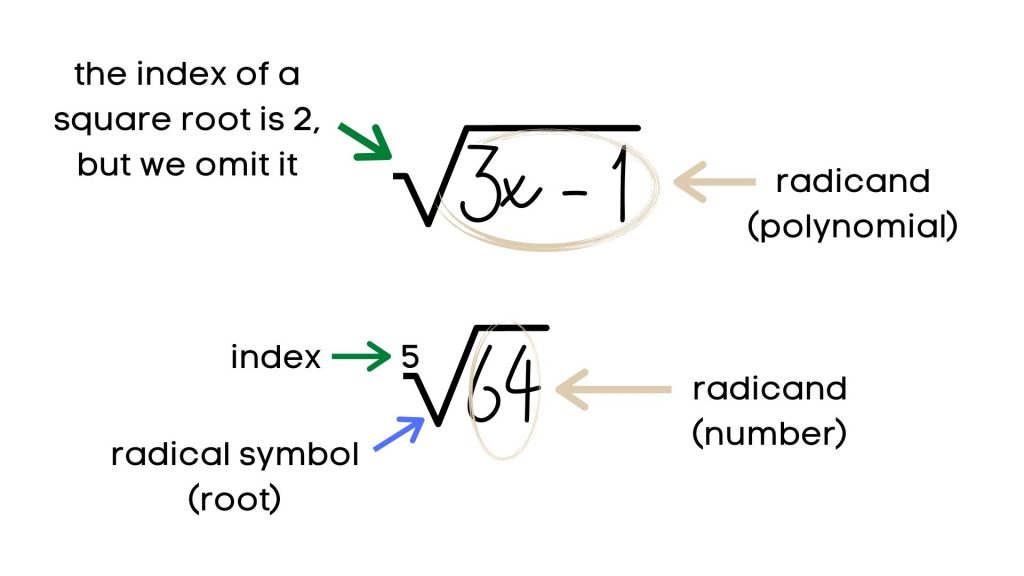
Radical expressions are used to express values in their exact form instead of an approximate form.
Radicals are inverses of rational exponents.
Key ideas: Radical Expressions
- Simplify by taking out perfect-square factors: √72 = √(36 × 2) = 6√2. A radical is fully simplified when no perfect square (other than 1) divides the number under the root.
- Add/subtract only like radicals (same number under the root), like collecting like terms: 2√3 + 5√3 = 7√3.
- Multiply: √a × √b = √(ab); multiply coefficients with coefficients and radicands with radicands.
- Rationalize a denominator: multiply top and bottom by the radical (for √a) or by the conjugate (for a ± √b, use a ∓ √b).
Worked examples
Example 1
Simplify 3√8 + 5√18.
- √8 = 2√2 and √18 = 3√2.
- 3(2√2) + 5(3√2) = 6√2 + 15√2.
- Answer: 21√2
Example 2
Simplify (2√3)(5√6).
- Coefficients: 2 × 5 = 10. Radicals: √3 × √6 = √18 = 3√2.
- Answer: 30√2
Example 3
Rationalize a) 6/√3 b) 4/(√5 − 1)
- a) Multiply by √3/√3: 6√3/3 = 2√3.
- b) Multiply by the conjugate (√5 + 1)/(√5 + 1): denominator (√5)2 − 12 = 4.
- 4(√5 + 1)/4 = √5 + 1
Common mistakes
- Adding unlike radicals: √2 + √3 is not √5.
- Splitting a radical over addition: √(9 + 16) = 5, not 3 + 4.
- Not simplifying first, so like radicals are missed (√8 and √18 are both multiples of √2).
- Multiplying only the denominator when rationalizing.
Questions students ask
Why rationalize the denominator?
It is the standard simplified form and makes expressions easier to compare and combine.
What is a conjugate?
The same binomial with the opposite sign between the terms: a + √b and a − √b. Their product has no radical.
Simplifying Radical Expressions
We can simplify radical expressions containing a square root by converting them into mixed radicals. In order to do that, a radicand needs to be split into a product of terms, at least one of which is a perfect square (for example, a 4 is a perfect square of 2). Then, take the square root of a perfect square and multiply it by the remaining radical as a coefficient.
We can add and subtract radicals that have the same root and radicand (just as we do with like terms in a polynomial).
We can multiply radicals by multiplying their coefficients and radicands separately.
Take a quizWatch how to simplify and perform operations on radicals:
Rationalize Denominator
Radicals can be a part of rational expressions. When there is a radical in the denominator, we need to rationalize the denominator that is eliminate the radical expression from the denominator. It is done so that it is easier to perform further computations involving that rational expression and so that the value of the expression is more obvious.
In order to eliminate a radical (most commonly a square root) containing a radicand that is a number from the denominator, just multiply both the numerator and the denominator of a rational expression by the radical.
In order to eliminate a radical containing a sum or a difference of two terms, one of which is a square root radical, multiply both the numerator and the denominator of a rational expression by a conjugate of the expression in the denominator. A conjugate pair is, for example, (x – 1) and (x + 1) – two expressions that differ only by their sign. The product of such conjugates will always result in a difference of squares – in the case of multiplying the expressions with a square root term, such product will help eliminate the root.
Watch how to rationalize a denominator:
Check your understanding
Practise with the Grade 11 quizzes. You’ll see right away if each answer is correct.