
Lesson 7: Simplifying Expressions with Exponents
Lesson 7: Simplifying Expressions with Exponents
Apply exponent laws to simplify algebraic expressions.
Simplifying expressions with exponents is an important skill that is required to comfortably work with different types of functions and their equations. It is especially useful when solving polynomial and rational equations.
We already looked at the concept of exponent in previous grades. However, we only operated integer exponents.
In this lesson we are moving further and learning about rational exponents and their properties.
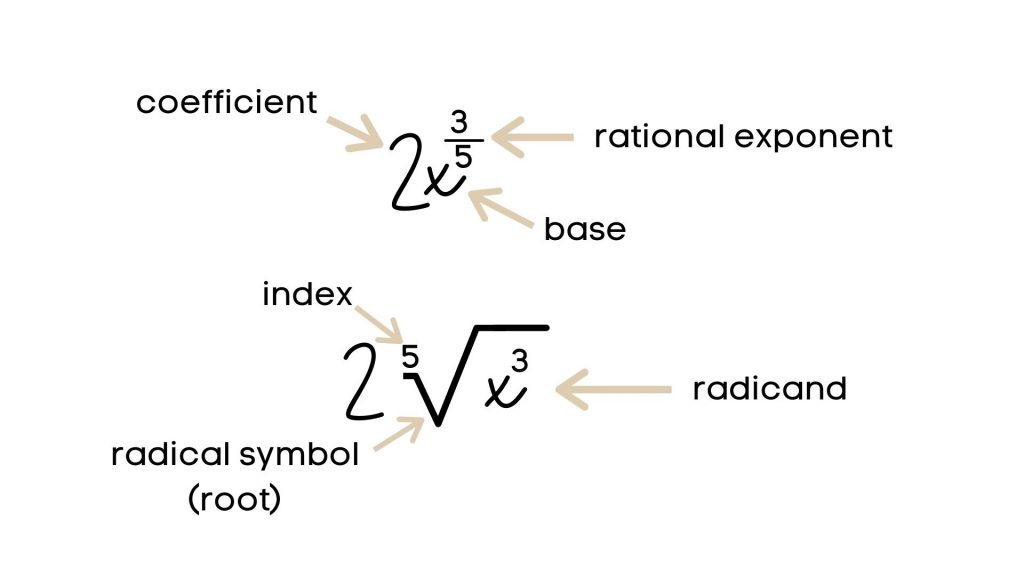
A rational exponent is an exponent expressed as a fraction m/n.
A power containing a rational exponent can be transformed into a radical form of an expression, involving the n-th root of a number.
The n-th root of a number a is another number, that when raised to the exponent n produces a.
We are also practicing how to use negative exponents in this lesson and discussing the difference between even and odd exponents.
In addition, we are analyzing the base of 0 raised to a rational exponent.
Simplifying expressions with exponents requires us to use a variety of exponent laws and properties. We may start with a really complex expression that, when simplified, could result in one variable or a number.
For example, in order to simplify the following expression, it makes sense to express what we can in terms of the same base and use exponent laws:


As you can see, we used the Power law of exponents, as well as the quotient law to simplify this expression. It is not uncommon that these simplifying expressions with exponents requires us to think a little bit outside of the box, see ways that we can express and transform numbers in order to apply laws to them.
Exponents Short Animation
Key ideas: Simplifying Expressions with Exponents
- am × an = am + n; am ÷ an = am − n; (am)n = amn
- (ab)n = anbn; a0 = 1; a−n = 1/an
- Rational exponents: a1/n = ⁿ√a and am/n = (ⁿ√a)m. The denominator is the root; the numerator is the power.
When simplifying, a “final answer” usually has each base once and only positive exponents.
Worked examples
Example 1
Simplify (4x3y−2)2 ÷ (2xy)3.
- Numerator: 16x6y−4. Denominator: 8x3y3.
- Divide: 2x6 − 3y−4 − 3 = 2x3y−7.
- Answer: 2x3/y7
Example 2
Evaluate a) 272/3 b) 16−3/4
- a) Cube root first: ∛27 = 3, then 32 = 9.
- b) 163/4 = (⁴√16)3 = 23 = 8, so 16−3/4 = 1/8.
Example 3
Simplify (8a6)1/3 and write √(x5) as a power.
- (8a6)1/3 = 81/3 × a6/3 = 2a2.
- √(x5) = x5/2.
Common mistakes
- Applying a negative exponent to the coefficient only, or to everything: 2x−3 = 2/x3, not 1/(2x3).
- Taking the power before the root with large numbers (272 then cube root is harder than ∛27 first).
- Writing am/n as the m-th root instead of the n-th root.
Questions students ask
Is 161/2 the same as √16?
Yes. An exponent of ½ means square root, so 161/2 = 4.
Can I leave a negative exponent in my answer?
Usually not; teachers expect positive exponents unless the question says otherwise.
Simplifying Expressions with Exponents Quiz

Check your understanding
Try the quiz for this lesson. You’ll see right away if each answer is correct.