
Lesson 6: More About Decimals
Lesson 6: More About Decimals
Build on decimal skills with more practice and operations.
In this lesson you will learn more about decimals.
You will practice how to determine the place value of the digits within the decimal and why it is important to understand the place value of each digit when converting decimals to percent.
For example, does 0.1 represent 10% or 1%? Why? You would need to multiply 0.1 by 100 to find the percent equivalent of this decimal, which results in 10%. It is easy to multiply any decimal by 100, since all you have to do is just move a decimal point 2 digits to the right of the original position.
In this lesson you will also learn how to compare decimals and how to multiply decimals.

When multiplying a natural number by a decimal, ignore the decimal and multiply the two numbers as natural numbers, then put a decimal point in the same place value as it was in the original decimal (tenths, hundredths, etc.).
Multiplying Decimals Activity
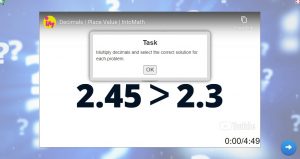
Key ideas: More About Decimals
Decimals go to thousandths (0.001). When you multiply by 10, 100 or 1000, the digits move 1, 2 or 3 places to the left (the number gets bigger). When you divide, they move to the right.
To multiply a decimal by a whole number, multiply as if there were no decimal point, then put the point back so the answer has the same number of decimal places.
Worked examples
Example 1
Order 0.305, 0.35 and 0.3 from least to greatest.
- Write with three decimal places: 0.305, 0.350, 0.300.
- 0.3 < 0.305 < 0.35
Example 2
Calculate a) 4.56 × 100 b) 37.2 ÷ 10
- a) Move two places: 456
- b) Move one place: 3.72
Example 3
Calculate 2.75 × 4.
- 275 × 4 = 1100. Two decimal places: 11.00.
- 11
Example 4
Calculate 12.5 − 7.68.
- 12.50 − 7.68.
- 4.82
Common mistakes
- Thinking 0.35 < 0.305 because 305 > 35.
- Moving the decimal point the wrong way when multiplying or dividing by 10.
Questions students ask
Why does multiplying by 10 move the decimal point?
Each digit becomes 10 times bigger, so it moves to the next place on the left.
Check your understanding
Practise with the Grade 6 quizzes. You’ll see right away if each answer is correct.